Make trauma exposure tracking part of the response.
A record of a difficult job is useful when it helps someone act. CaseNote connects exposure, peer support and follow-up, giving authorised teams a clearer view of who needs attention and what happens next.
See how the workflow connects → Explore the good practice mapping →
The guidance is about the response as well as the exposure. The October 2026 Practice Note 005 from Natural Hazards Research Australia explains how emergency services can apply the good practice principles to the systems around their workforce. It calls for a clear purpose, practical design, appropriate data, secure handling, useful analysis and ongoing review.
For a program lead, that means being able to follow the thread: who was exposed, what support was offered and whether the next action happened. That is the work CaseNote brings together.
After a difficult job, make the next step visible
Consider a team returning from a difficult incident. The incident record tells part of the story. Your support team also needs to know who was involved, who has been contacted and what is still outstanding. CaseNote connects those pieces through a shared record and clear follow-up responsibilities.
- 01RecordLink affected members to the incident and record the exposure.
- 02ReviewUse exposure alerts and contact gaps to prioritise attention.
- 03RespondRecord a support contact, referral or other response.
- 04Follow throughGive the next action an owner and due date, and track its status.
For coordinators, this means less reliance on remembering who needs a call. For peer supporters, it gives contact and follow-up a defined place in the workflow. For program leaders, it makes the work of the service easier to review.
Inside CaseNote · Early warning for program leads
How the principles show up in everyday work
The six elements provide a useful way to assess a tracking system. Here is how they translate into concrete CaseNote behaviour, with the relevant points from the good practice guide alongside each example.
01 · Purpose
Make the welfare purpose visible
Peer supporters see a scope-of-practice reminder when recording a note. Individual peer reports explicitly frame the information as supporting welfare and supervision. Role and assignment controls restrict visibility, while clinical information stays behind a separate access boundary.
Good practice 1.1 and 1.3 · Purpose, scope and shared understanding
02 · Design and implementation
Make follow-up part of the workflow
Structured contact forms, member links to a shared incident and follow-up reminders connect the record to the next action. Assigned tasks carry an owner, due date and status, so responsibilities remain visible when work passes between people.
Good practice 2.5.1 and 2.5.2 · Capability, usability, access and reporting
03 · What is collected
See the response as well as the event
Member–incident links capture who was exposed. Organisational response records can show a welfare check, referral, scheduled follow-up or declined offer. Contact records add the support provided and any follow-up needed, with clinical notes held separately.
Good practice 3.4, 3.5 and 3.6 · Incident information, people and organisational responses
04 · Collection and storage
Build privacy into access
Sensitive fields are encrypted. Server-side role and member-access checks restrict records, clinical-field redaction protects clinical information, and audit records support review of access and changes.
Agreed integrations can also reuse existing records, with the source, data scope and connector work agreed for the organisation.
Good practice 4.2 and 4.3 · Linked information and safeguards
05 · Analysis and use
See where attention is needed
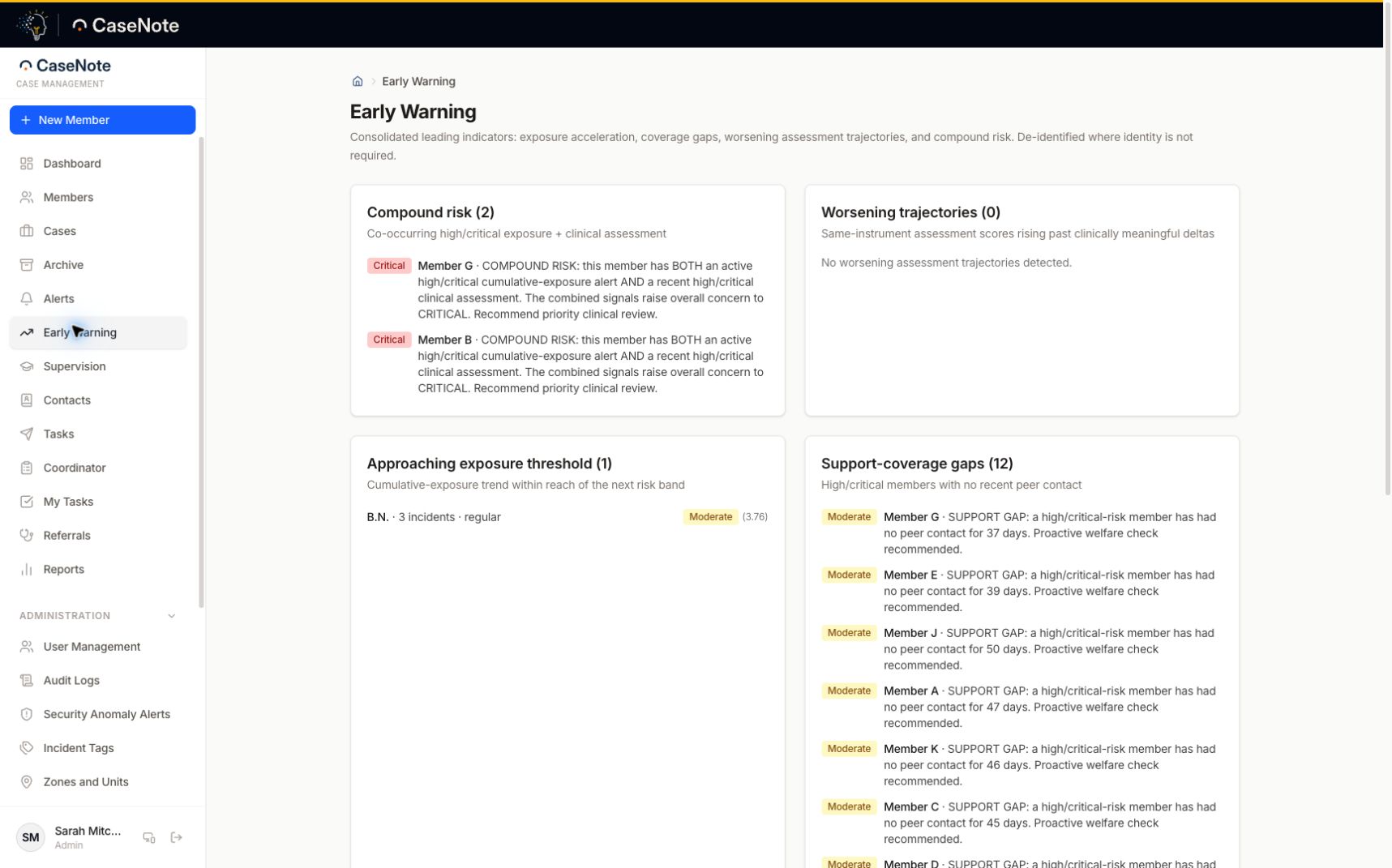
Acute and cumulative exposure alerts and support-gap views help authorised coordinators prioritise review. Tasks make the follow-through visible. At program level, team-health reporting uses aggregate counts and small-group suppression to show patterns of risk.
Good practice 5.3 and 5.5 · Actionable insights and useful reporting
06 · Monitoring and evaluation
Show what the program is doing
Contact histories, follow-up status, task records, reports and audit trails show the work recorded, what is outstanding and how the system has been used. They give program leads information to review delivery and identify where the process needs attention.
Combine that record with workforce feedback to guide improvements.
Good practice 6.1 and 6.3 · System monitoring and continuous improvement
Exposure indicators are prompts for a supportive review, not clinical diagnoses or predictions. Reporting should be matched to its audience and purpose, with privacy protections checked for each output.
See the workflow against your own questions
A demonstration is most useful when it follows the work your team actually does. Choose a typical scenario and the questions you would want answered afterwards. We can walk through a realistic program using synthetic data:
- Who was exposed? See how members link to a shared incident record and how exposure contributes to the coordinator's view.
- What happened next? Follow a support contact through the record, the next action and its status.
- Who can see what? Compare the peer-support and clinical boundaries, and the information available to different roles.
- What can leadership learn? Review team-level patterns and the records that support a conversation about the program.
Use that walkthrough to test fit with your workforce, responsibilities and existing systems. A successful implementation also needs consultation, training, a resourced support response and ongoing review.
Quick answers
What should a trauma exposure tracking system record?
A useful tracking system records who was exposed, relevant incident information and the organisational response, including support contacts, referrals and follow-up. Clinical notes need a separate access boundary.
How does CaseNote support the good practice principles?
CaseNote links exposure records with support contacts and follow-up tasks, reinforces the welfare purpose on relevant screens, restricts information by role and provides reports for program review. Its mapping to selected principles is a vendor interpretation, not certification or endorsement by the publishing organisations.
Can exposure tracking diagnose or predict mental health conditions?
No. Exposure indicators can prompt a supportive review, but they do not diagnose a condition or predict an individual outcome. Tracking should sit within a broader mental health and wellbeing strategy with a resourced support response.
Sources and context
The framework was developed through research, sector consultation and expert input. It provides flexible guidance; evidence about the benefits of tracking systems remains limited. The original guide states that tracking exposure alone has not been shown to improve workplace mental health and wellbeing. [1, p. 7] [2, principle 1.2]
- [1] Howard A, Pedder D, Watson L, Bowd C. Tracking trauma exposure and organisational responses: How emergency services can implement good practice. Natural Hazards Research Australia, Practice Note 005, October 2026. See pp. 4–7.
- [2] Howard A, Pedder DJ, Watson L, Savic A, Huckvale K, Sadler N. Good practice principles for tracking potentially traumatic events exposure and organisational responses in emergency services. Phoenix Australia for Natural Hazards Research Australia, Report No. 49.2025, December 2025.
- Research project and implementation resources, including the Tracking System Audit and accompanying materials.
The CaseNote mapping is our interpretation of selected principles; it does not imply certification or endorsement by the publishing organisations. Point descriptions are shortened paraphrases. This guide is general information, not legal, clinical or professional advice.