Repeated exposure adds up. Most programs have no way to see it.
The people who run toward the emergency attend traumatic events as part of the job, and the research is blunt about what that costs. Beyond Blue's Answering the Call study, the national study of Australia's police and emergency services (21,014 current and former personnel, published 2018), found high or very high psychological distress in one in three employees, and probable PTSD in about one in four former employees.
Yet in many organisations, the peer-support program carrying this load still runs on spreadsheets, inboxes and goodwill. Contacts go unrecorded. Exposure history lives in people's memories. Nobody can say which members are carrying the most, and when a regulator, a court or a coroner later asks what the organisation knew and did, there is no record to point to.
The evidence is sharpest for emergency services and other trauma-exposed work. The duty is not confined to them: every Australian employer now has an explicit obligation to manage psychosocial risk at work, and to be able to show they did.
See risk while there is still time to act.
The latest CaseNote release adds a psychosocial suite built around ISO 45003, the international standard for psychological health and safety at work. It measures the hazards the NSW Code names, watches for early movement in individuals and teams, and turns what it finds into scheduled follow-through.
· = suppressed below n = 5
A trend projection, not a clinical prediction. Labelled that way in the product too.
Early-warning dashboard
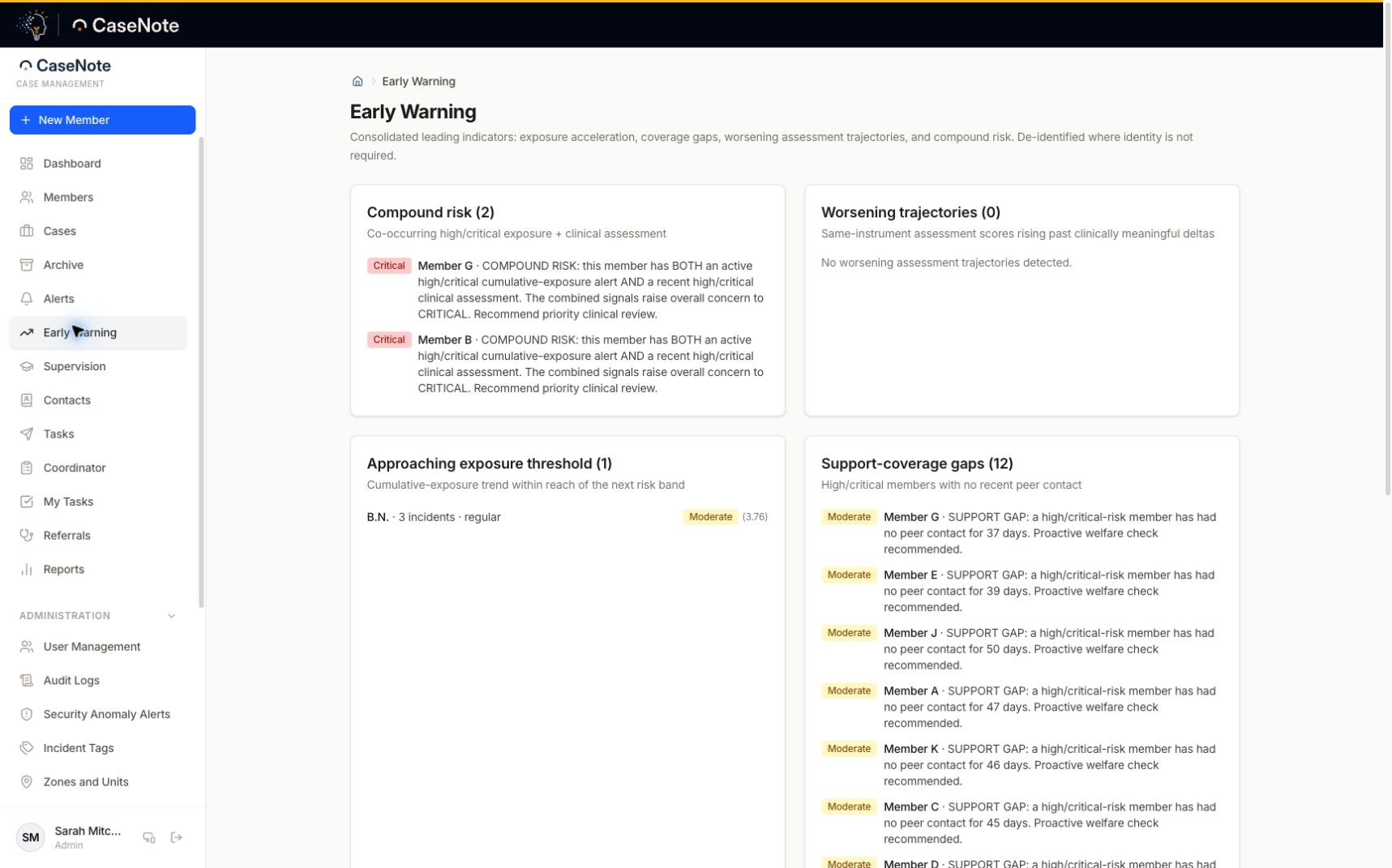
One screen for program leads: members whose assessment scores are worsening across repeated screens, compound risk where high exposure meets high clinical scores, members approaching an exposure threshold, and high-risk members with no recent peer contact.
Screening that runs itself
ProQOL-5, the Copenhagen Burnout Inventory and WHO-5 join the clinical instruments. After a major incident, affected members are scheduled to receive wellbeing pulses at 48 hours, 14 days and 28 days, and any member can opt in to a periodic check-in. Results land on the member's record like any other assessment.
Anonymous hazard survey
A 24-item survey across eight hazard categories, from job demands and role clarity to traumatic-event exposure. Responses are anonymous by design and never linked to a person, small groups are suppressed automatically, and each category is benchmarked against your baseline and your targets.
Team-level intelligence
A team by risk-band view for executives and program managers, built from counts only. It shows where load is concentrating without opening a single member's record.
Projection you can explain to a board
Where a member's trajectory is worsening, CaseNote projects when it would cross the next risk band within an eight-week horizon. The rules are transparent, there is no black box, and the result is labelled in the interface as a trend projection, not a clinical prediction.
Follow-through, generated
The suite creates the work it implies: supervision nudges when a peer supporter's own exposure runs high, wellbeing check-ins ahead of the anniversary of a major incident, and supervisor tasks when training or supervision currency lapses.
Care for the carers
Peer supporters track their own wellbeing with short structured check-ins. A low score, or a request for help, reaches a supervisor straight away.
A boundary, stated up front
CaseNote's Scope Statement confines exposure and wellbeing data to member support. It is never used for performance management, discipline, attendance management, surveillance or fitness-for-duty decisions. Published sector guidance is explicit that a tracking system must never become a surveillance tool; CaseNote is built to enforce that boundary, not merely promise it.
Every capability above ships with the same privacy architecture as the clinical record: role-based access, de-identification wherever identity is not required, and an audit entry for every access.
Want to see the suite on realistic synthetic data?
Since 1 July 2026, the psychosocial Code of Practice is enforceable in NSW.
NSW employers have had an explicit duty to manage psychosocial risks since October 2022, and SafeWork NSW's Managing psychosocial hazards at work Code of Practice has described what good management looks like since 2021. What changed on 1 July 2026 is enforceability: a new section 26A of the Work Health and Safety Act 2011 (NSW) requires every organisation to comply with approved codes of practice, or to manage the same risks another way that meets an equal or higher standard.
The primary duty of care
An organisation must ensure, so far as is reasonably practicable, the health and safety of its workers. The Act's definition of health includes psychological health, so the duty has always covered minds as well as bodies.
Managing psychosocial risks
In force since 1 October 2022 and carried into the remade 2025 Regulation, these sections require employers to identify psychosocial hazards and control them using the hierarchy of controls. SafeWork NSW names exposure to traumatic events among the common hazards. Policies and training alone do not discharge the duty: controls must reach how work is designed, resourced and supported.
Approved codes of practice become enforceable
Inserted by the Industrial Relations and Other Legislation Amendment (Workplace Protections) Act 2025 and in force from 1 July 2026, section 26A ends the era of codes of practice as merely persuasive guidance in NSW.
Section 26A, in plain terms
Where the Minister has approved a code of practice, a person conducting a business or undertaking must either:
(a) comply with the code, or
(b) manage the hazards and risks in a different way that provides a standard of health and safety “equivalent to or higher than the standard required under the code”.
The SafeWork NSW psychosocial Code is an approved code of practice, so complying with it, or demonstrating something better, is now a statutory duty for every NSW organisation. Section 26A sits among the Act's health and safety duties and is enforceable through improvement notices, prohibition notices and the Act's offence provisions.
Officer due diligence
Directors and senior managers must exercise due diligence to ensure the organisation complies with its duties, including verifying that the resources and processes for managing psychosocial risk exist and are actually used. The duty is personal to the officer.
What the consequences look like
A solicitor prosecuting sexual-offence cases developed PTSD from the work. The High Court held that for roles like hers, the employer's duty required proactive steps, not a response after the injury had already appeared.
After a workplace suicide and findings of trauma exposure, role conflict and excessive workloads at the Coroners Court, Court Services Victoria was convicted under Victoria's OHS Act and fined $379,157, the maximum available, plus costs. A landmark Australian prosecution for psychological harm.
Serious mental-health claims reached 17,600 in 2023-24 (preliminary), up 161 per cent over ten years. The median claim (2022-23) meant $67,400 in compensation and 35.7 working weeks away.
Work health and safety laws in every Australian state and territory require psychosocial risks to be managed; section 26A is a NSW addition on top. CaseNote's compliance layer is configured to your jurisdiction during onboarding. This page is general information, not legal advice.
The full picture, in a document you can hand to your executive.
One record from first welfare check to clinical care.
The psychosocial suite sits on a complete case-management platform that runs the day-to-day of a wellbeing program: for the peers who make first contact, the clinicians who carry the caseload, and the leaders who answer for both.
For peer support programs
Contact logs in seconds
Quick contact capture designed for use between jobs, so the work peers already do is counted instead of lost. Wellbeing checks and structured escalation live in the same place.
A clearly bounded peer role
Peers never see clinical detail; the boundary is enforced in the database, on both the read and the write side. Senior peer roles get wider coordination tools without crossing the clinical wall.
Coordination without spreadsheets
Task assignment with priorities, due dates and a my-tasks queue, plus training-currency tracking with auto-calculated expiry for every peer-program role.
Cumulative exposure tracking
Every potentially traumatic event is weighted for severity, volume, recency and frequency. A member's exposure history follows them across their whole service, not just this season's spreadsheet.
For clinical and mental health teams
Validated screening instruments
C-SSRS, PHQ-9, GAD-7, DASS-21, PCL-5 and K-10, completed anywhere through single-use secure token links. A critical response raises an alert the moment it is submitted.
A defensible clinical record
SOAP and DAP notes, treatment plans kept distinct from peer support plans, and signed, locked records with dated addenda.
Closed-loop external referral
Review-gated referral intake, and an external-provider portal where outside clinicians see only what is referred to them, members appear as first name and last initial, and the outcome writes back to the record as a closing note.
Alerts that reach someone
Assessment results, exposure thresholds and manual concerns all feed one alert queue with acknowledgement and resolution tracked, so nothing critical waits in an inbox.
For oversight and WHS
De-identified reporting
Workload, exposure, geographic hot-spot and privacy reporting for program managers and executives, de-identified by default with small groups suppressed.
Privacy tooling
Subject access requests with the statutory clock tracked, de-identified exports, and hosting in Australia.
CaseNote's peer-support model follows the guidelines published by Phoenix Australia (Australia's National Centre of Excellence in Posttraumatic Mental Health) and the peer-support literature they draw on: early contact, a bounded peer role, clear referral pathways, supervision for the supporters, and confidentiality with narrow, sanctioned exceptions. CaseNote has also been reviewed against Report No. 49.2025, the good-practice principles for tracking potentially traumatic event exposure published by AFAC, Natural Hazards Research Australia and Phoenix Australia in December 2025, and maps to all six of its elements. These are alignments with published guidance; CaseNote is not endorsed by, or affiliated with, any of these organisations.
The most sensitive record your organisation holds, treated that way.
Per-record encryption
AES-256-GCM with a separate key for every record, wrapped by a master key held in a secrets manager. A single compromised row stays a single row.
Role-based access, enforced low
Clinicians, supervisors, duty officers and peers each see only what their role permits. The filter is applied at the database query, not in the interface.
Strong authentication
Multi-factor authentication for every role with access to clinical data, short idle and absolute session timeouts, and full session governance.
Append-only audit trail
Every access and change is logged by field name, never by content, so the audit trail itself can never leak what it protects.
Tenant isolation
Each organisation runs in its own isolated environment with its own database and its own encryption keys. No co-mingled data, ever.
Australian data residency
The application and its databases are hosted in Australia.
Breach readiness, built in
A data-breach register aligned to the NSW Mandatory Notification of Data Breach scheme, with eligibility assessment and notification tracking, ready before it is ever needed.
Access anomaly detection
Scheduled checks watch for unusual patterns: mass exports, access at unusual hours, repeated denied attempts. Administrators are notified automatically.
Retention, enforced
Retention policies are applied automatically: expired records and their encrypted files are purged on schedule, so data you no longer need is data you no longer hold.
Low risk, time-boxed, and entirely yours.
We stand up an isolated tenant for your organisation, onboard a small cohort, and prove the workflow end to end before you commit to anything.
Scope and stand-up
We agree a cohort and outcomes, then provision your isolated tenant with your branding and roles.
Run the program
Your peers and clinicians use CaseNote for a defined trial window, with onboarding and support included.
Review and decide
We review exposure visibility, response times and feedback together. Your data stays yours, exported or deleted on request.
Why CaseNote exists
CaseNote is designed and built by a serving emergency services duty officer and trained peer supporter, out of years spent watching peer programs run on spreadsheets and memory. It is built for the people who run toward the emergency, and for every workplace that carries psychosocial risk.
Bring CaseNote to your people.
Tell us about your organisation and we'll be in touch about a pilot. No obligation.